A flat $10 per person, per month
Time tracking and invoicing that bills you for people, not paperwork.
If your time tracker started charging you by the invoice, the project and the client, this is somewhere to land — with a decade of billing history intact.
No credit card required.
- $10
- per person who signs in, per month
- 0
- objects metered: not clients, projects, tasks or invoices
- 1
- dry run before a row of your history is written
The timesheet
A week, and what it is worth.
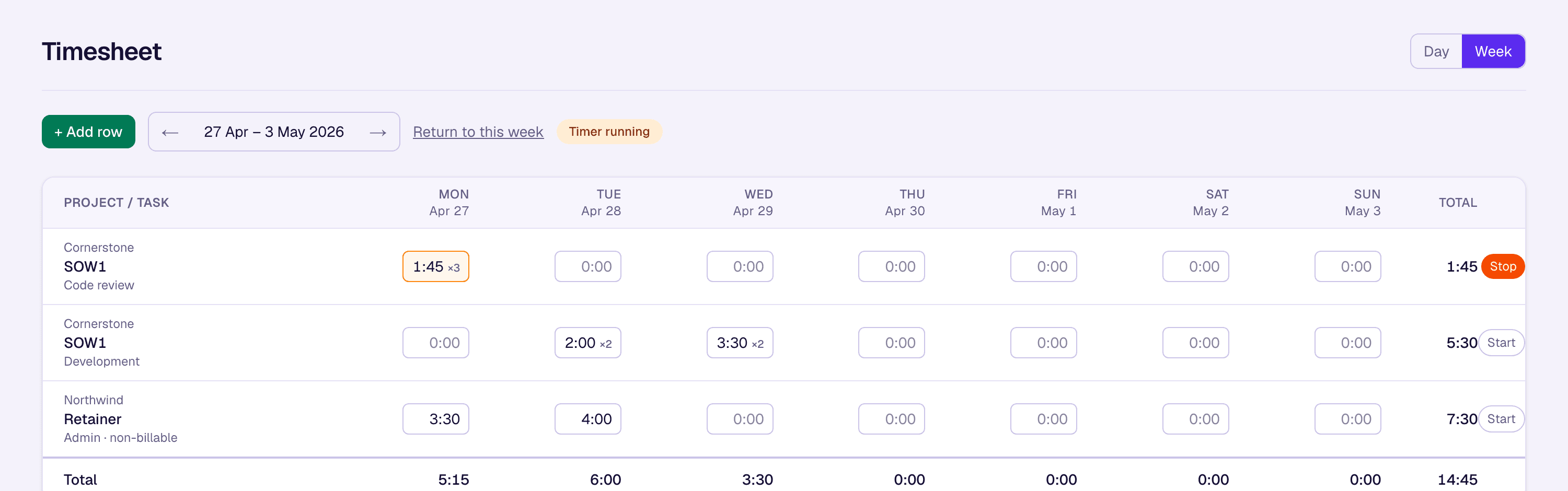
Project and task down the side, days across. A cell holding several entries shows their total and opens them individually, so the grid can never disagree with its own footer.
- Type 7:15 or 7.25, whichever you think in
- A running timer, or fill the grid in on Friday
- Non-billable rows marked, so nothing is billed by accident
Approvals
What approval is holding up, in money.
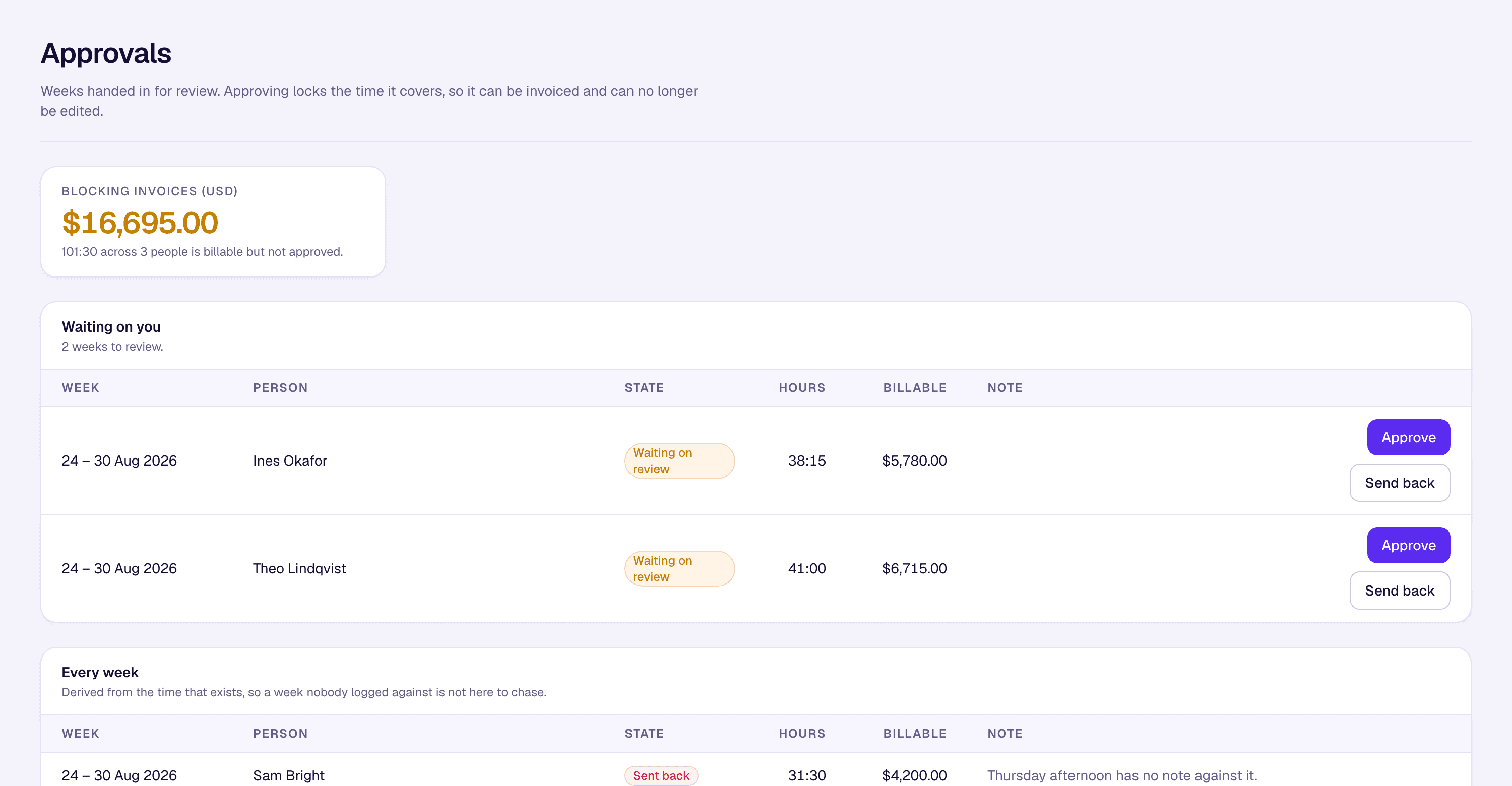
A week is submitted, approved, or sent back with a reason. The figure at the top is billable work that cannot be invoiced yet because nobody has approved it.
- Sending a week back requires a comment
- Approving locks the time it covers
- Approval state is filterable in every report
Pricing
One plan, because there is nothing to put in a second one.
Other trackers reserve approvals, expenses, budgets, cost rates and multiple currencies for a higher tier, then meter the objects you create. Here the only number that moves your bill is how many people sign in.
- ApprovalsSubmit a week, approve it, or send it back with a reason.
- Locked timeApproved and invoiced hours stop being editable, in the database.
- Task ratesA rate per task per project, not one rate for the whole account.
- RoundingPer-account rounding rules, applied to what gets invoiced.
- ExpensesReceipts, categories, mark-up, and expenses onto invoices.
- BudgetsPer project, per task and per person, by hours or by money.
- Multiple currenciesPer client, never added together into one misleading total.
- Cost rates and marginWhat an hour costs you against what it bills for.
- InvoicingDrafts, sending, payments, voids, reissues, public client links.
- ReportsSaved filters, run on demand, exported as often as you like.
- The importerHarvest CSV and API, with a dry run before anything is written.
- Every objectClients, projects, tasks, invoices. Uncounted and uncapped.
What it does
A studio's billing, end to end.
Hours in one end, an invoice a client can pay out the other, with the margin visible in between.
Timers and timesheets
A running timer, or a weekly grid you fill in on Friday. Hours as 7:15 or 7.25, whichever you think in.
Approvals that report
Submit a week, approve it, or send it back with a reason. Then see what approval is holding up, in money.
Invoicing from tracked time
Group by task, person, project or entry. Non-billable hours can go on at zero, so goodwill is visible.
Expenses and mark-up
Receipts, categories, pass-through costs and mark-up, landing on the same invoice as the hours.
Rates that hold their history
Bill rates per person, per task, per project. Cost rates per person. Both dated, so the past stays put.
Reports you can save
Filter by client, project, person, task, billable state or approval state. Run them whenever.
Migrating
Bring a decade of history, and check it before it lands.
Moving billing history is the part that goes wrong, so it is the part built first. The importer writes nothing on the way in.
Step 1
Land
Your export is stored verbatim, byte for byte, with a content hash.
Step 2
Normalize
Thousands separators, three date conventions, four column layouts.
Step 3
Validate
Anything ambiguous becomes a discrepancy to resolve, never a guess.
Step 4
Dry run
A full report of what would be written. Nothing has been written yet.
Step 5
You approve
Check the totals against Harvest. This is the point of the exercise.
Step 6
Commit
Written in one pass, then reconciled against the source figures.
Correctness
The numbers are the product.
A billing tool that is a cent wrong across forty thousand entries is worse than none, because nobody notices. Four decisions that are not negotiable:
Money is exact, never a float
Every amount is stored in minor units with its ISO currency code and added with exact arithmetic. Rounding happens in one place, and only where someone has named the mode.
Currencies refuse to mix
Adding dollars to euros throws rather than quietly producing a number. Reports bucket per currency, because a single total across currencies is a lie.
Rates are effective-dated
A raise today does not rewrite what a client was billed last year. The rate is stamped onto the entry when it is written, so a historical invoice keeps reproducing the figure actually charged.
Sent invoices do not change
Once a client has a copy, its line items are immutable. Void and reissue leaves a record; a silent edit leaves two versions and nothing saying they differ.
What this is not
Some things are missing on purpose.
Every one of these ships in a competing tracker's higher tier. They are not on a roadmap here.
No screenshots
We do not photograph anyone's screen. A timesheet is a record of work, not evidence against the person who did it.
No GPS or location tracking
Where somebody was standing is not an input to an invoice.
No activity or idle monitoring
Keystroke counts and mouse movement measure compliance, not value, and the studios buying this bill for judgement.
Nothing is ever logged automatically
We will suggest a meeting that has no entry against it. We will never write the entry for you. That line is the difference between helpful and surveillance.
Your renewal went up. Your client list did not get more valuable.
$10 per person per month, $8 paid yearly, and nothing else counted.
No credit card required.